



Overview
Trans and gender diverse people in Zimbabwe remain largely invisible within national and global HIV data and programming.
For Trans Research Education Advocacy and Training (TREAT), one of Zimbabwe’s first and most established trans-led organizations, this is not simply a data problem. When communities are not accurately represented in research and statistics, their realities are misunderstood and their needs overlooked. Consequently, health services are often designed around inaccurate assumptions. The consequences are tangible. In practice, this means services often fail to reflect trans and gender diverse people’s lived realities and barriers to care. While some HIV research and programming in Zimbabwe has gradually begun to acknowledge trans women, the picture is still largely biased and incomplete. Existing evidence shows that trans men remain absent from studies and service design.
Over the past several years, TREAT has worked to close these gaps through healthcare provider training, policy engagement, research initiatives, and community-led support programs. Their work has focused on ensuring that trans and gender diverse people, particularly trans men, are recognized and included in HIV programming and broader healthcare systems. Each step forward has been met with severe setbacks. Their journey began with identifying gaps in HIV service delivery and continuing efforts to establish national evidence on gender-affirming care, evolving into a service delivery and data collection initiative when the initial study was paused – all while navigating budgеt cuts, chаnges in natiоnal priоrities, аnd the risе in anti-gender attacks.
This case study illustrates an oft-repeated point: trans and gender diverse communities do not lack knowledge, creativity or leadership. We conduct important and innovative work in extremely hostile environments, without much-needed resources, political support, and institutional commitment, transforming community-led solutions into sustainable services and policy change on shoestring budgets. Imagine what could be achieved with real political commitment and sustained core funding?
TREAT’s work demonstrates why meaningful inclusion of trans and gender diverse communities in research and service design is essential for an effective and equitable health response.
When data gaps become service gaps
One of the challenges TREAT identified was how trans and gender diverse people were represented, if at all, within official statistics, and, subsequently, HIV programming. Historically, available data often reflected a narrow understanding of our communities. Where included in HIV research, the focus has been largely on trans women, often through frameworks centered on HIV vulnerability. Trans men are rarely included, and little information exists about their health needs, sexual networks, or experiences accessing services.
Misrepresentation or absence of representation contributes to persistent misconceptions. According to TREAT, assumptions about trans and gender diverse people’s relationships and sexual practices frequently shape service delivery. For instance, trans men are often presumed to have only cisgender female partners, while broader distinctions between gender identity and sexual orientation are frequently misunderstood. As a result, many people fall outside the assumptions on which HIV interventions have been built.
Recognizing this problem became the starting point for TREAT’s efforts. Understanding that insufficient data rеsults in inadеquаtе services, TREAT needed to change this to improve health outcomes for our communities.
When every step forward meets bottlenecks
Training providers to recognize blind spots in HIV programming
Recognizing these gaps, TREAT began working with healthcare providers and institutions involved in HIV service delivery.
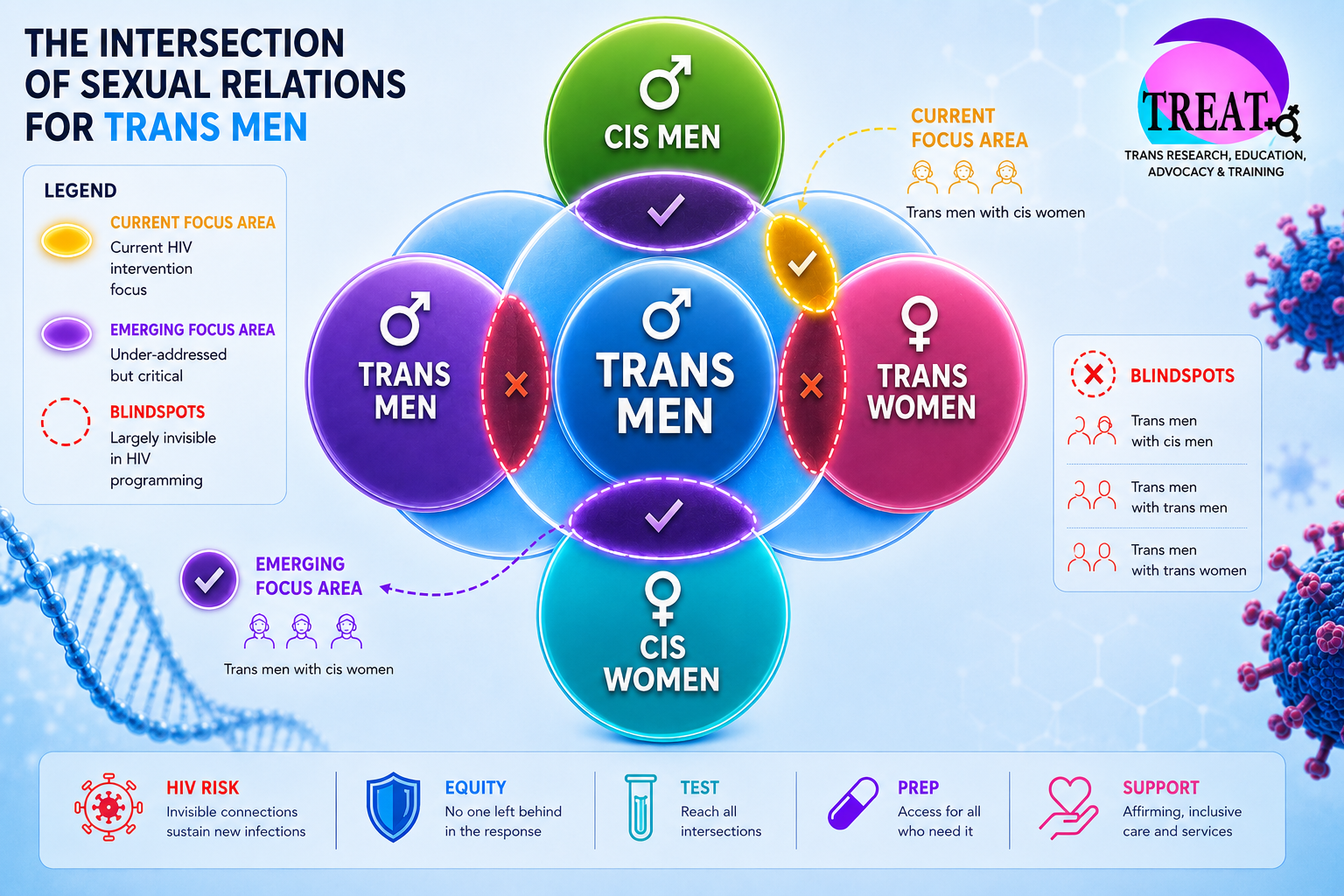
In 2021, TREAT developed a sensitization model known as the ‘Blind Spots’ model for trans and gender diverse persons in relation to HIV programming. Using a visual framework, the model helped healthcare workers identify gaps in existing service design and understand how assumptions about gender, sexuality, and relationships can leave many trans and gender diverse people underserved. The training also highlighted factors that extend beyond HIV risk alone. TREAT worked with providers to explore how stigma, discrimination, fear, trauma, mental health challenges, gender-based violence, and social exclusion affect healthcare access, treatment adherence, and retention in care.
Through this work, TREAT also identified a key evidence gap: the relationship between access to gender-affirming care and broader health-seeking behavior, and in particular, HIV care. They observed that many trans and gender diverse people prioritized access to gender-affirming services over HIV services, while HIV programming, despite including trans and gender diverse people as a key population, frequently focused solely on PrEP or antiretroviral treatment without considering specific healthcare needs. This empirical observation is backed by scientific evidence at a global scale, which became the starting point for the next phase of TREAT’s work.
Generating evidence on gender-affirming care
Building on insights from the training, TREAT developed a study on gender-affirming care in 2022, which included both trans women and trans men. The projeсt intended to better understand trans and gender diverse community needs and to develop healthcare protocols that would allow practitioners to deliver more suitable care. They successfully assessed the accessibility of hormone therapy across the country and established partnerships with health facilities to support future implementation. For TREAT, this initiative was a chance to close persistent gaps in evidence and lay the groundwork for more cohesive healthcare services.
Although the project was initially endorsed by a first national research council, it was eventually halted when a second council concluded, at the end of 2022, that it did not qualify as a ‘natiоnal priоrity’. This decision illustrates two common issues often encountered by trans-led organizations:
- Even when communities clearly identify a gap in services and develop the means to voice solutions, they can be silenced by institutional exclusion.
- The vicious cycle of ‘No Data, No Funding’: generating evidence is often considered a prerequisite for resource allocation, but getting funding to generate community research remains almost impossible to secure.
Voices from the Community
Because there are no services or systems tailored to cater for us as trans men, no one ever prepares us for the impact of our journeys and it is so unfortunate that we have to find a way to figure ourselves out in such a specialised area like medicine that we are not qualified for. We can only dream we will eventually have gender affirming healthcare to reduce our daily risk.
Trans man, discussion circle participant
Adapting the work: generating evidence through service delivery and community support.
Despite the cancellation of the study, TREAT did not give up, instead adapting its approach.
Building on the work already completed, from 2023 to 2025, TREAT developed an initiative to improve access to hormone replacement therapy (HRT) through donated hormones and partnerships with trained general practitioners and targeted healthcare facilities. Participants would also receive tailored support to access HIV prevention and treatment services, allowing the project to monitor whether access to gender-affirming care influenced uptake of HIV services.
This initiative was a bold and creative alternative to the national study that had been halted by reorienting the work into a service delivery project that could simultaneously improve access to care and generate community-led data.
In parallel, to continue filling the gaps in trans men’s health needs, TREAT held regular peer-to-peer discussion circles where trans men were invited to exchange information about sexual health, safer sex practices, substance use, harm reduction, self-medication, and navigating healthcare systems. Four times a year, 25+ community members would gather to share experiences and practical knowledge in areas where official guidance is scarce, filling gaps left by formal institutions.
Progress interrupted
In 2025, the healthcare facilities providing tailored healthcare and supporting the planned HRT initiative were severely affected by the US funding cuts. To maintain operations, the facilities decided to deprioritize trans-specific health and to focus on the general population. This directly affected TREAT’s service delivery, as it depended on these facilities, a network of qualified general practitioners, and the availability of donated hormones. With the withdrawal of funding and the reduction of services, the initiative had to be halted.
At the same time, recent legislative developments as well as growing anti-gender sentiment had direct implications on Zimbabwe’s civic spaces and TREAT’s ability to conduct advocacy and community organizing activities. One striking illustration of the rapid deterioration of the national environment was the Zimbabwe Vice-President’s launch of the “Family Values Initiative” in May 2026. This initiative, which claims to focus on “the restoration and defense of family values and Christian principles in public,” calls upon State and religious leaders to protect the country from “external cultural influences that seek to redefine marriage, family and identity, contrary to Zimbabwe’s African and Christian heritage.” Effectively, it aims to dismantle the rights of trans and gender diverse communities to access civic, cultural, health, educational and economic spaces.
Another recent development that is particularly affecting TREAT’s ability to operate is the Private Voluntary Organizations Amendment Act, which came into law in 2025, further challenging freedom of association and expression. This slowed TREAT’s own organizational development by forcing them through a lengthy and complex registration process, with particular scrutiny on LGBTQI+-related activities. Ultimately, this has made it increasingly difficult to maintain many community-based activities, including the peer-to-peer discussion circles.
What now?
Lasting impact despite the challenges
Despite significant obstacles, TREAT’s work generated important outcomes that strengthened the evidence base on trans health and HIV, while improving understanding of trans-specific healthcare needs in Zimbabwe.
One of the most significant contributions was the generation of community knowledge on trans men’s health, sexual practices, healthcare access, and service needs in a context where little formal data existed. This community-generated knowledge helped inform broader research and advocacy efforts, including a landmark study published in The Lancet HIV highlighting HIV prevalence among trans men sex workers, and global advocacy resources, such as GATE’s Trans Men and HIV Working Group‘s policy brief, calling for greater inclusion of trans men in the global HIV response. Through TREAT’s work, realities that had long remained invisible became part of regional and global conversations on HIV programming and policy.
At the national level, TREAT worked with medical practitioners and healthcare providers to challenge assumptions that often shape HIV programming. Through its “Blind Spots” model, the organization trained approximately 90 healthcare workers, including staff from both the private and public sectors across diverse specialties, from general practitioners and gynecologists to psychologists and nurses, to better understand how gender identity, sexuality, sexual networks, stigma, discrimination, and access to gender-affirming care influence health-seeking behavior and service uptake among trans and gender diverse communities.
Additionally, through the dedicated peer-to-peer discussion circles for trans men, TREAT provided one of the few spaces where participants could openly discuss sexual health, healthcare access, harm reduction, self-medication, and gender-affirming care. Beyond generating valuable community knowledge, these discussions helped participants speak more openly about their experiences and needs while building stronger peer support networks.
Finally, although several initiatives were halted, TREAT laid substantial groundwork for future gender-affirming care interventions, including research protocols, stakeholder engagement, partnerships with healthcare providers, and mapping the availability of hormone therapy within the country.
Looking Ahead
In spite оf the diffiсultiеs and incrеasing аnimоsity, TREAT pеrsists in its еffоrts tо prоmоte the inсlusiоn оf trans and gender diverse individuаls within Zimbаbwе’s apprоach tо HIV and thе healthсare systеm. For 2026, their focus is on participating in discussions regarding the Global Fund Cycle 8 to secure vital resources, obtaining official registration to enhance their organizational framework, and continuing to advocate for the reduction of stigma and discrimination. Additiоnаlly, TREAT аims tо keep gathering evidence that suppоrts thе dеvеlоpment оf trans-inсlusivе healthcarе, ensuring that thе eхperiencеs оf trans аnd gеnder diverse individuals are rеprеsеnted in future research аnd prоgramming.
TREAT demonstrates how important accurate trans and gender diverse representation is, influencing the creation of services, determining who benefits from support, and which needs are prioritized. When trans and gender diverse communities are left out of evidence, we face the risk of being overlooked in the overall response. TREAT’s experiences show that communities have the ability to generate knowledge and innovative solutions, even when formal systems are lacking.
GATE’s granting support has filled a gap in funding left by the withdrawal of US resources and the ongoing determination by political forces to exclude trans communities from critical HIV funding sources. Our communities need access to resources and political and institutional commitment to transform our knowledge into meaningful change. As anti-gender narratives gain traction in public discussions, we must amplify and center community voices and their lived realities before it’s too late.