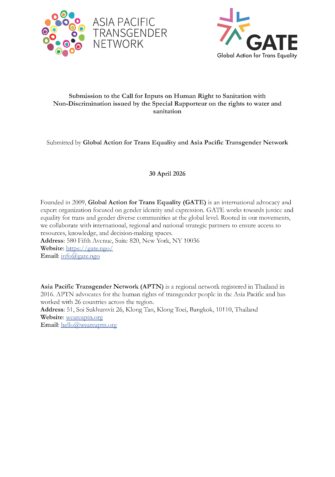

On 30 April, GATE, in collaboration with the Asia Pacific Transgender Network (APTN), submitted a report to the Call for Inputs from the Office of the High Commissioner for Human Rights (OHCHR) in relation to the Human Right to sanitation with non-discrimination, as it applies to trans and gender diverse people.
Summary
This submission emphasizes that access must be safe, dignified, and free from discrimination based on SOGIESC, while highlighting how current systems and frameworks fail to adequately recognize and address the specific needs of our communities.
It also identifies structural and legal challenges, including binary and gender-segregated sanitation infrastructure, criminalization and legal restrictions on gender identity and expression, lack of inclusive policies and disaggregated data, and pervasive stigma and social hostility that limit safe access to sanitation facilities.
What are the challenges?
The above-mentioned barriers result in serious consequences, including:
- negative physical health outcomes such as dehydration and infections, significant mental health risks including anxiety and suicidal ideation,
- restricted freedom of movement and access to work,
- exclusion from menstrual health services, and
- increased exposure to harassment, violence, and abuse in both public and custodial settings.
Recommendations to protect the right to sanitation with non-discrimination:
The submission calls for the
- repeal of discriminatory laws,
- adoption of SOGIESC-inclusive legal protections,
- expansion of all-gender and inclusive sanitation facilities, ensuring safe access in all settings, including detention, integration of inclusive menstrual health policies, systematic collection of disaggregated data, and
- strengthened intersectional and adequately funded WASH policies and programs.