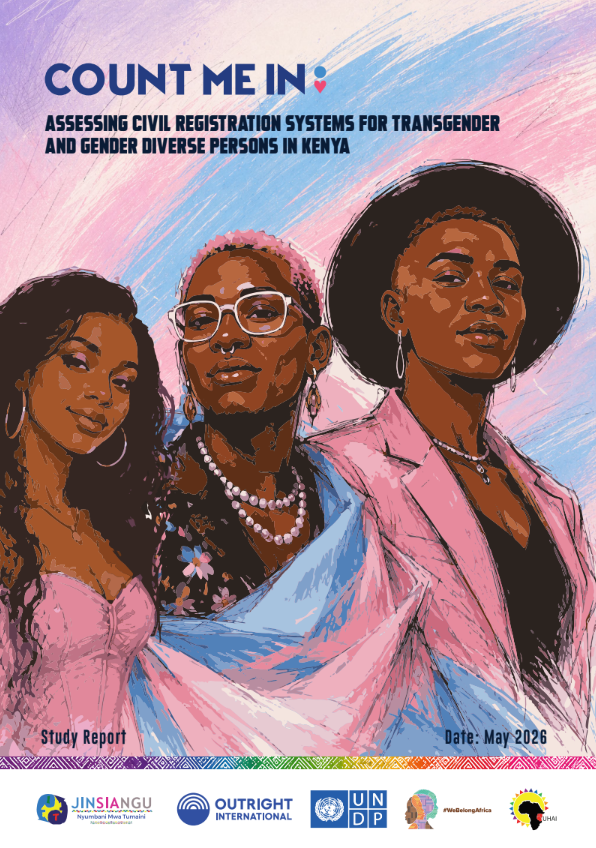

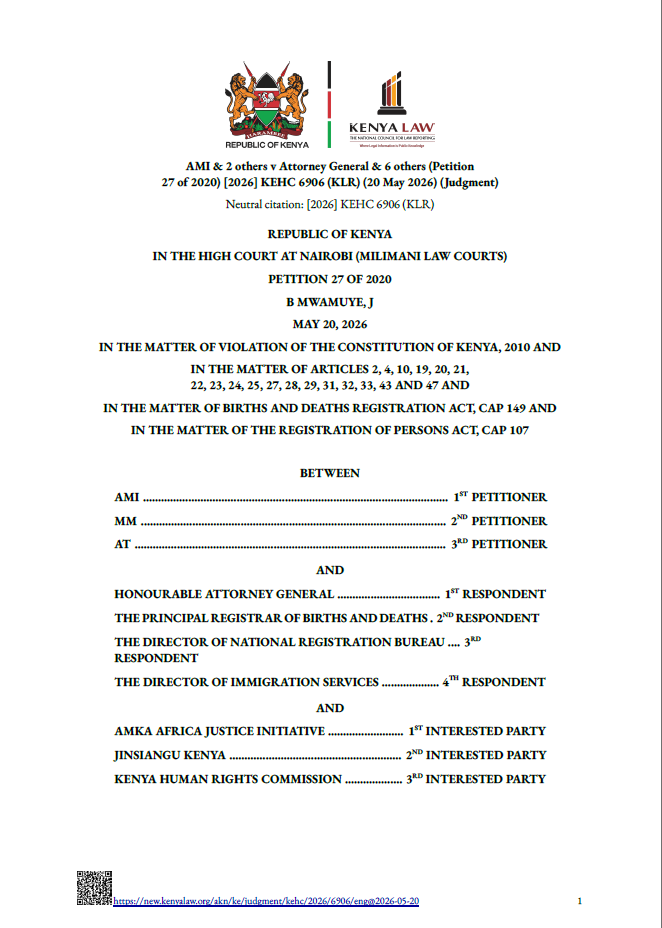
Kenya’s High Court has affirmed that trans and gender diverse people have a constitutional right to legal gender recognition – a landmark ruling that establishes, for the first time, a legal basis for correcting gender markers on birth certificates, national IDs, and passports of trans and gender diverse Kenyans. Delivered on 20 May 2026 by Hon Justice Bahati Mwamuye MBS of Nairobi’s Milimani High Court, the decision comes after 94% of trans and gender diverse Kenyans had been refused by civil registration offices, with some spending the equivalent of nearly four years’ wages in failed attempts to correct their documents.
What did the Kenyan High Court actually decide?
While it has been possible for Kenyans to change their name through a legal deed poll process, Kenya has never had a codified legal framework for gender recognition. Prior to this ruling, there was no clear administrative pathway for trans and gender diverse people to change their gender markers, meaning that even those who had successfully changed their name were left with identity documents that told a different story.
The case was brought to court through Petition 27 filed in January 2020 by three trans Kenyans – Audrey Mbugua Ithibu, Maureen Muia, and Arnest Kaku Thiaya – after they were repeatedly denied changes to their gender markers despite having legally changed their names. Petition 27 argued that these refusals violated their constitutional rights to dignity, equality, privacy, and fair administrative action. The petition addressed all three of Kenya’s foundational identity documents – the birth certificate, the national ID, and the passport – as correcting downstream documents alone would leave individuals still vulnerable, with their original records continuing to contradict their legal identity.
The ruling affirms that the right to live in accordance with one’s gender identity is protected under Kenya’s constitutional guarantees of dignity and expression – rights that belong to every Kenyan, not only those whose gender identity was recorded correctly at birth.
What has the absence of legal gender recognition cost trans and gender diverse Kenyans?
“An identity document that does not reflect who you are or what you look like exposes you every time you use it – opening a bank account, starting a job, signing a rental lease, passing through an airport, or seeing a doctor.” – Jinsiangu
For trans and gender diverse Kenyans, this exposure has been a daily reality. The evidence gathered in building the legal case documents the scale of the harm. Prior to the ruling:
- 94% of trans and gender diverse Kenyans had been refused by civil registration offices when attempting to alter their gender markers.
- Some had spent more than KSh 500,000 – approximately US $3,865, or close to four years of average wages for this community – in failed attempts to correct their documents.
- Three in four reported being turned away, humiliated, or denied service at a government registration office at least once.
These figures are drawn from Count Me In, a 2026 national study co-authored by Jinsiangu, a Kenyan trans-led organization and GATE member that has been central to both the legal case and the community support work surrounding it. For Jinsiangu, the evidence gathered through that research was not only documentation, it was the foundation of the legal argument.
“Community members had repeatedly submitted applications, medical reports, legal documents, and requests to government agencies but were met with silence, delays, requests for non-existent procedures, or outright refusals. For some petitioners, these attempts stretched back more than a decade.” – Toni King’ori, Executive Director, Jinsiangu
Audrey Mbugua, one of the three petitioners, first formally engaged the National Registration Bureau in 2013. By the time judgment was delivered in 2026, no resolution had yet been provided. Her case alone spans 13 years of the Kenyan State failing to act.
How did Kenya get here? A decade of deliberate legal work
The May 2026 ruling is not a sudden breakthrough. It is the product of more than ten years of disciplined, incremental, often unglamorous legal work, carried out by activists and lawyers who understood that lasting change is assembled one precedent at a time.
It began in 2013, when Audrey Mbugua won the right to have her academic certificates amended, followed by a parallel case in 2014 that secured the right of a trans-led organization to be officially registered. This established that trans and gender diverse people had the right to be represented by an official organization.
Cases taken in 2018 and 2019 won the right to have name changes reflected on national ID cards. In 2025, a High Court in Eldoret went further still, awarding damages to a trans woman who had been wrongfully arrested and detained, and ordering Parliament to legislate trans-specific protections – a directive that remains unacted upon.
Petition 27 was built deliberately on each of those earlier foundations. It targeted the core issue that previous cases had not resolved: the gender marker on the birth certificate, from which a person’s national ID and passport ultimately flow. Correcting downstream documents alone would leave individuals still vulnerable. Petition 27 went to the root.
Arnest Kaku Thiaya, one of the three petitioners, did not live to see the outcome. An elder whom many call the father of Kenya’s trans movement, he passed away during the course of the litigation. After his death, Jinsiangu stepped in with technical support for the legal team, gathering community evidence and expert testimony that would form the evidentiary basis of the case.
What does this ruling require the Kenyan government to do?
The Court has instructed the Registrar of Births, the National Registration Bureau, and the Immigration Department to establish proper procedures for amending gender markers on official documents, replacing what has until now been a system of gatekeeping and guesswork with a system grounded in due process and rights. Following the issuance of the court’s final orders, government agencies will have a 60-day window to bring their practices into line with the updated guidelines. Jinsiangu will be monitoring compliance and engaging directly with agencies on practical implementation.
“We expect trans and gender diverse people to be able to access identity documents that accurately reflect who they are. This should reduce barriers to employment, healthcare, education, banking, housing, travel, and government services. It should also significantly reduce forced disclosure, public humiliation, and exposure to violence that often arise when identity documents do not match a person’s lived gender.” – Toni King’ori, Executive Director, Jinsiangu
Beyond compliance monitoring, Jinsiangu will also provide community education on what the judgment means and who may benefit from it, legal referrals and support for individuals seeking to use it, and documentation of experiences during implementation to identify barriers or gaps as they emerge.
What remains unresolved
While the ruling is a landmark, it does not resolve every question facing trans and gender diverse Kenyans. The country’s laws remain built on a binary framework, and how corrected gender markers interact with that framework has not yet been tested in court. Marriage laws, inheritance, adoption, trans healthcare and treatment within the criminal justice system all raise unresolved questions – questions that this judgment creates the conditions to answer, but does not answer itself.
The 2025 Eldoret ruling ordering Parliament to legislate trans-specific protections also remains unimplemented. The High Court can affirm rights; it cannot, on its own, build the legislative architecture needed to sustain them. That work remains ahead.
A Win Against a Global Tide
This ruling arrives at a moment when the rights of trans and gender diverse people face coordinated attacks in countries across the world. That context does not diminish what Kenya has achieved, but amplifies it.
In the UK, the Supreme Court ruled in April 2025 that the legal definitions of ’sex’, ‘man’, and ‘woman’ under the Equality Act 2010 refer strictly to biological sex assigned at birth. The decision effectively strips trans and gender diverse people of legal protection under the Act, even those who hold a Gender Recognition Certificate. Crucially, it establishes a precedent that allows organizations and businesses to exclude trans people from single-sex spaces by default.
In India, a recent amendment to the Transgender Persons (Protection of Rights) Act has rolled back the right of self-identification. The revised law narrows the definition of transgender to traditional socio-cultural identities, excluding transmasculine, transfeminine, and non-binary people who do not fit those categories, while mandating invasive medical boards’ verifications for those who do.
In Ghana, lawmakers recently advanced the Human Sexual Rights and Family Values Bill, which criminalizes not only same-sex relationships but also the act of identifying as LGBTQ+, and imposes severe prison sentences on organizations, advocates, and individuals who provide support or housing to sexual and gender minorities.
Set against this backdrop, the Kenyan High Court ruling carries weight beyond its borders. At a moment when legal identity is being weaponized as a tool of exclusion elsewhere, Kenya’s court has affirmed the opposite principle: that the constitution belongs to everyone, and that the State has an obligation to reflect that in the documents it issues.
How to support trans and gender diverse communities in Kenya?
You do not need to be a trans or gender diverse person, or an activist, to understand what is at stake here. At its core, this ruling is about a simple democratic principle: that the State should treat people consistently, fairly, and respectfully, and that the rules should be written down and grounded in rights rather than the prejudice of individual officials.
The ruling is a victory, but implementation is not guaranteed. The 60-day compliance window for government agencies is a deadline, not a promise. The work of turning a court order into a functioning administrative process, one that trans and gender diverse Kenyans can actually use without fear of humiliation or refusal, is ongoing, and it requires sustained attention and support.
There are concrete ways to help. In the immediate term, amplifying accurate information about the judgment supports community legal education and ensures that trans and gender diverse people understand what they are now entitled to. Monitoring and documenting implementation challenges and encouraging government agencies to comply fully with the court’s orders keeps pressure on the process. Financial, technical, psychosocial, and legal support for affected community members addresses the real barriers that will arise as individuals begin to navigate the new procedures for the first time.
In the longer term, the unresolved questions this ruling leaves open – on marriage, inheritance, adoption, trans healthcare and the criminal justice system – will require sustained advocacy for the policy and legislative reforms needed to build a legal gender recognition framework that is clear, fair, and accessible to all.
Organizations like Jinsiangu are doing this work now, as they have been for more than a decade. Supporting them is the most direct way to support the communities at the center of this victory.
Read the full judgment: Petition 27 of 2020
Read Jinsiangu’s 2026 national study: Count Me In