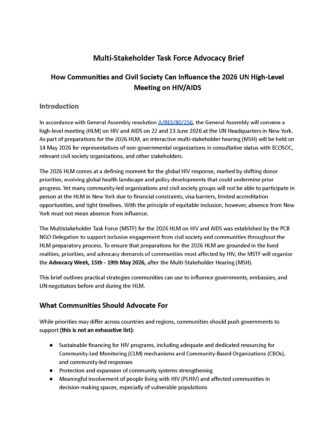

In advance of the 2026 High-Level Meeting on HIV and AIDS, the Multistakeholder Task Force (MSTF) was established by the PCB NGO Delegation to support inclusive engagement from civil society and communities throughout the HLM preparatory process.
To ensure that preparations are grounded in the lived realities, priorities, and advocacy demands of communities most affected by HIV, the MSTF will organize the Advocacy Week taking place from 15 to 19 May 2026, after the Multi-Stakeholder Hearing (MSH) on 14 May.
In the meantime, Priscilla Ama Addo and Erika Castellanos, co-chairs of the MSTF, created an advocacy brief to support civil society and community engagement. This was also reviewed by Best Chistsanupong, GATE Human Rights Officer and Pedro Ivo Oliveira, GATE Health Officer.
This advocacy brief outlines practical strategies communities can use to influence governments, embassies, and UN negotiators before and during the HLM.
You’ll learn how to:
1 Engage Governments Before Negotiations Begin
2 Engage Embassies and Diplomatic Missions
3 Make Use of Digital and Media Advocacy to Build Pressure
4 Build Coalitions and Coordinate Advocacy
5 Monitor Negotiations and Respond Quickly
Download the advocacy brief now
We also encourage you to stay tuned on UN Web TV to follow both the Multi-Stakeholder Hearing (MSH) on 14 May and the advocacy week from 15 to 19 May.
You can reach out to the Multi-Stakeholder Task Force at mstf2026@googlegroups.com