
Background & Context
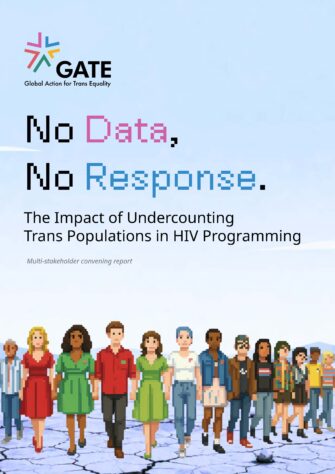
This report summarizes a May 2026 multi-stakeholder convening, which gathered 19 participants from diverse backgrounds, combining researcher, multilateral, donor, and civil society perspectives, organized by Global Action for Trans Equality (GATE) as part of the “Power in Q Data” project.
The project aims to improve population size estimates for trans and gender diverse communities, who are systematically undercounted within HIV response systems.
Current estimates of trans and gender diverse populations are often drawn from HIV programs that focus narrowly on trans women (specifically those in sex work), leaving trans men and gender diverse individuals invisible or bundled into broad ” key populations” categories. This systematic undercounting limits resource allocation and program design for a population facing high HIV vulnerability.
The report highlights key themes regarding the challenges of estimating the size of trans and gender diverse communities, outlined by participants, and the impact of undercounting them for HIV Programming.
Key Themes
- Systemic Gaps: Undercounting is not merely a technical issue but a result of systems designed without trans and gender diverse realities in mind. Existing frameworks often aggregate our communities into broader “key population” categories, masking specific health needs.
- Data Environments: Current systems are fragmented, and community-generated evidence is often deemed “not credible” by national or global entities. Furthermore, in criminalizing environments, collecting disaggregated data without adequate safeguards poses significant risks of surveillance to trans individuals.
- Community-Led Infrastructure: Participants argued that community-developed data systems are essential infrastructure and should be recognized as primary tools for informing HIV programming, human rights advocacy, and anti-gender legislation responses.
- Politics of Data: The undercounting is often intentional, directly impacting resource allocation. Advocacy must connect trans inclusion to human rights, public health, and economic efficiency to challenge existing resistance.
Based on the findings, GATE provided 5 key recommendations to address these gaps.
Conclusions
This report concludes that undercounting trans and gender diverse populations is the result of how HIV systems, funding structures, and political priorities continue to reproduce invisibility, which translates into exclusion from funding allocation, service provisions, and policies.
The central question is not whether knowledge exists – it does, even if it is only produced by communities themselves. The question is whether institutions are willing to recognize, protect, integrate, and fund it.
About Power in Q Data Project
Power in Q Data is funded by the Elton John AIDS Foundation and is a partnership between GATE and MPact Global. The project, started in 2025, aims to explore innovative community-led approaches to conduct population size estimates among trans and gender diverse populations for GATE and gay men and other men who have sex with men for MPact Global. The project directly results from long-standing concerns shared by trans-led organizations worldwide that trans and gender diverse population size estimates are unrealistic, in some cases unethically and criminally used, and are conducted without the input of our communities.